
Concussion
With more than 6 out of every 1,000 people affected, concussions are one of the most common sports injuries (5% of all sports injuries*). In the United States, between 1.6 and 3.8 million concussions occur every year**. Often underestimated and misdiagnosed, these shock injuries disrupt brain function, leading to increased and sometimes persistent cognitive risks, as well as neurodegenerative diseases*** such as chronic traumatic encephalopathy. In the absence of any specific curative treatment, care is limited to targeted interventions in the event of persistent symptoms.
* Journal of Rehabilitation Medicine, (2004)
In the sporting world, the sports mainly concerned are :
Head trauma and concussion
Traumatic brain injury (TBI), including traumatic brain injury (TBI) and concussion, is one of the world’s leading causes of disability. They are risk factors for neurological disorders, which can sometimes persist throughout the life of the affected patient.
These traumas, caused by violent impacts or jolts to the head, are most often the result of road accidents, assaults, falls, or injuries sustained in sporting, domestic or military contexts.
Often caused by acceleration and deceleration movements throwing the brain against bone walls, a concussion results in altered cerebral function (transient or persistent). The main symptoms are memory impairment with amnesia, loss of consciousness, diplopia, dizziness, balance disorders, headaches, sleep problems, attention disorders and disturbances of executive functions.
Head injuries are classified as mild, moderate or severe, depending on the duration of loss of consciousness, altered mental state and/or amnesia.
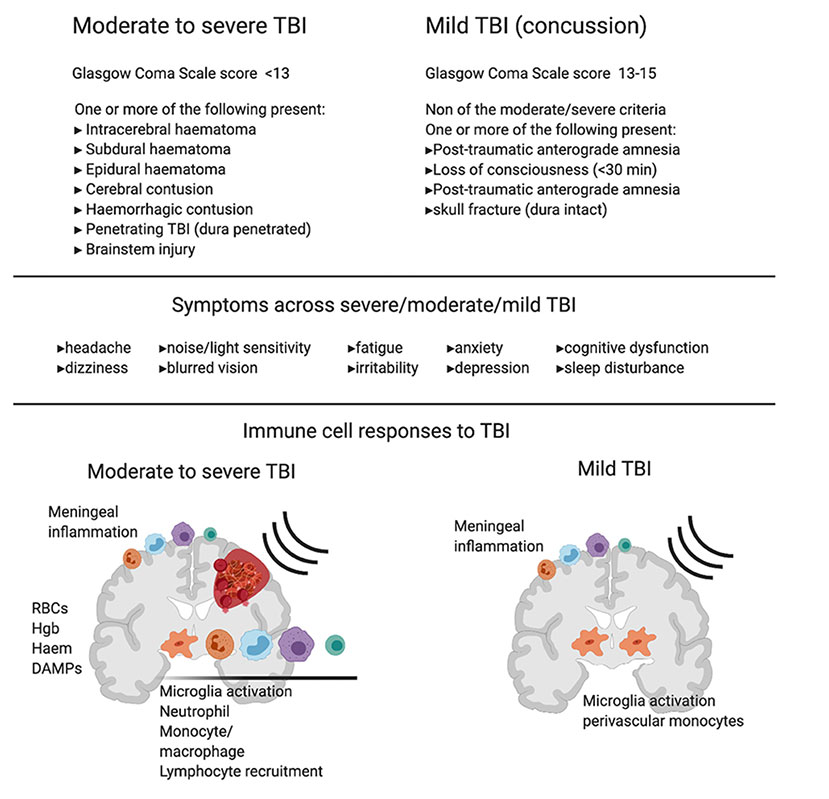
Source: Verboon et al., 2021
Repeated episodes of concussion, even without loss of consciousness, can have severe and irreversible cumulative effects. They are particularly common among boxers, rugby and American soccer players, and military personnel. Repeated head trauma can result in a much more serious condition: chronic traumatic encephalopathy. Even a physically recovered player can develop persistent neurological and cognitive disorders.
Physical, behavioral and cognitive effects of traumatic brain injury:
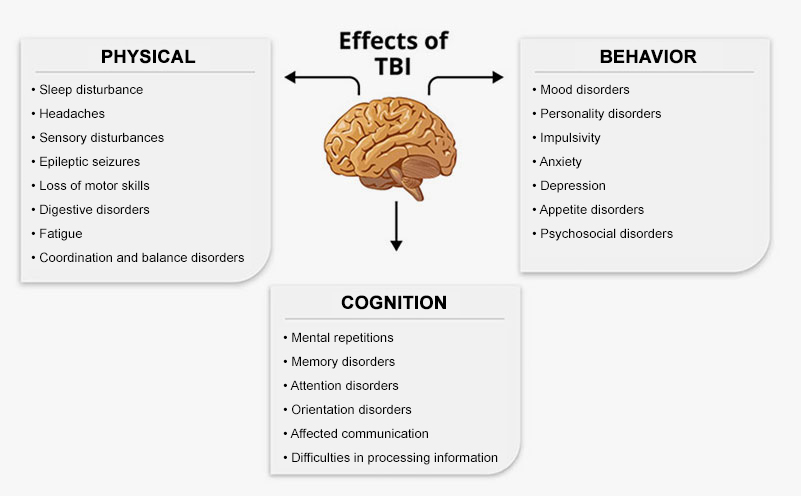
Source : Shah E et al. Frontiers in Neuroscience 13, April 2019.
Brain regions affected by traumatic brain injury
The frontal lobes are very sensitive to traumatic injury, but other areas of the brain can also be affected.
The areas affected by head trauma and its impact on normal life.
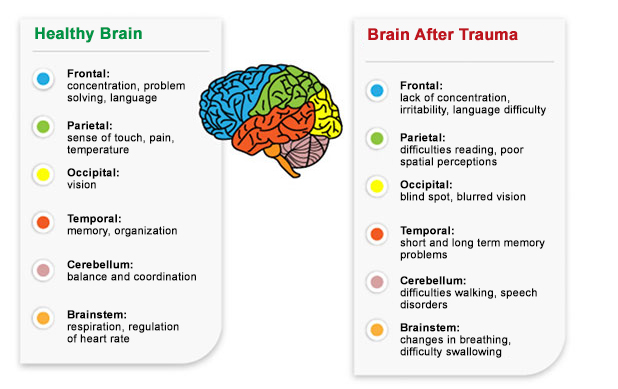
Source: Jarrahi et al., 2020
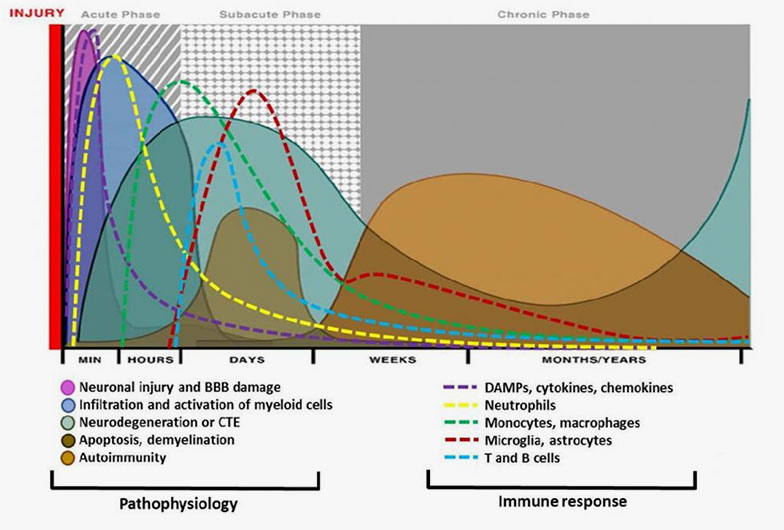
Traumatic brain injury leads to a series of neurochemical and metabolic events. In the acute phase, neuronal death, tissue loss, damage to the blood-brain barrier and neurodegeneration are observed. Subsequently, the immune response is representative of the chronic phase, with, among other things, upregulation of inflammatory factors.
Current research is also focusing on the mechanisms at play involving the immune system and the composition of the microbiota, and their impact on disease severity.
Disruption of the gut-brain axis is not the cause of head trauma, but it can nevertheless be a contributing factor in its complications.
Bidirectional interactions after head trauma
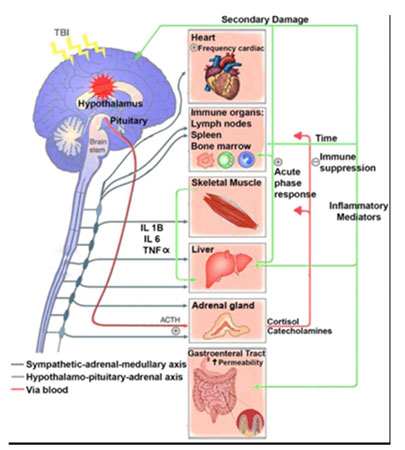
Head trauma not only affects the brain, but also provokes a stress response that triggers central inflammation and a multi-organ inflammatory response, involving the action of the autonomic nervous system and the hypothalamo-hypophyseal axis.
Source: Freire Royes, 2021
The impact of traumatic brain injury on the composition of the microbiota, combined with the risk of subsequent severe complications, underscores the value of REGEnLIFE technology, which targets both the brain and the gut.
Thus, the balance of the gut-brain axis and its proper functioning are essential for maintaining homeostasis, and hence good communication between organs.
Head trauma and Alzheimer’s disease: the cerebrovascular link
This link favors the development of therapeutic approaches for both traumatic brain injury and Alzheimer’s disease. Indeed, the pathology of chronic traumatic brain injury is similar to that of Alzheimer’s disease.
Several studies show that the release of β-amyloid and Tau proteins causes cerebrovascular lesions. The accumulation of β-amyloid and Tau in the brain’s microblood vessels leads to adverse consequences. In turn, vascular damage induces more β-amyloid and Tau deposits, which ultimately lead to cognitive impairment and the development of Alzheimer’s-type pathology.
Source: Ramos Cerudo, 2018
Photobiomodulation is now emerging as a potential treatment for concussion.
Initial results from REGEnLIFE’s RECOVERY pilot clinical study on acute concussion in athletes
RGn550 shown to be safe, well-tolerated and effective in a pilot clinical study of concussion in athletes