
From his fascination with therapeutic light to the challenges posed by European regulations, Guillaume Blivet explains how REGEnLIFE is striving to bring a pioneering medical innovation from the laboratory to the patient’s bedside, without resorting to shortcuts or following passing trends.
Some words eventually lose their impact through overuse. ‘Innovation’ is one of them. Guillaume Blivet, Director of Innovation and co-founder of REGEnLIFE, prefers to ground it in reality: coming up with an idea is one thing; turning it into a scientifically validated solution that is accessible to patients is quite another. His field of expertise? Brain photobiomodulation, a non-invasive approach that could offer new hope to patients with neurological conditions such as Alzheimer’s disease or depression.
Medtech France: When you hear the word “innovation” in a meeting, are you the sort of person who rolls their eyes, or do you reach for a notebook to take notes?
Guillaume Blivet : Neither, actually. First and foremost, I listen carefully to understand the context in which the word “innovation” is being used. If it’s relevant and based on concrete facts, then yes, I take notes. That said, I remain cautious, as it’s a term we hear a lot, and one that needs to be backed up by substance and action. And then, coming up with an innovation is one thing; actually bringing it to fruition is quite another.
M.F : Your background doesn’t necessarily suggest you’d end up working on the brain and photobiomodulation. What made you take this detour or make this choice?
G.B : It’s true that, on the face of it, nothing suggested I would end up working on the brain and photonics. But life sometimes has surprises in store for us, and the people we meet shape our journey. I discovered phototherapy technologies through discussions with dermatologists at conferences. I was fascinated by the results they were achieving, particularly in relation to certain skin conditions and wound healing. These techniques included photobiomodulation, which uses near-infrared light applied to biological tissues to modulate cellular activity and achieve therapeutic effects.
As I explored the field further, I met several key players in the sector, and it was against this backdrop that I co-founded REGEnLIFE in 2016. Whilst delving into the scientific literature, I came across the first neuroscience publications on the applications of transcranial photobiomodulation (a non-invasive technique applied to the surface of the skull) and I couldn’t stop thinking about it. It is still an emerging approach compared to TMS (transcranial magnetic stimulation) or tES (transcranial electrical stimulation)…
Having initially trained in public health, I saw this as a unique opportunity: to develop a non-invasive neurotechnology for conditions where treatment options are very limited. Alzheimer’s disease, which affects tens of millions of patients worldwide, stood out as an obvious choice, given its human, societal and economic impact. If an effective, side-effect-free and accessible treatment were to exist, it would be a game-changer.
As the company’s initial leader, I was tasked with overseeing R&D and innovation right from the start. Although I wasn’t a specialist in the field, my curiosity and eagerness to learn enabled me to develop my skills. I also enjoyed working in a multidisciplinary environment – encompassing physics, engineering, neuroscience, neurology and more – and sharing expertise with my co-founders. I was also fortunate enough to cross paths with Professor Jacques Touchon, an internationally renowned specialist in Alzheimer’s disease, who became our scientific advisor and is now chair of our scientific advisory board. He has been a valuable mentor to me, and I have learnt a great deal from him.
M.F: Do you have a ritual (reading, exercise, a way of thinking) that helps you “create” clarity when the technological fog thickens?
G.B : Yes, I have a few habits that help me regain clarity when things get complicated. Having shared my life for a few years with someone from Mumbai, I had the chance to travel to India and discover Vipassana meditation, one of the oldest forms of meditation and the origin of mindfulness. Although I only practise it occasionally, it has given me useful cognitive habits that help me step back and calm my mind. Beyond that, walking, going to the gym, yoga and even rock climbing help me stay focused and prevent my mind from going blank.
M.F: You’re talking about cerebral photobiomodulation, a technology that is still relatively unfamiliar to doctors. How can you avoid being labelled as ‘pseudo-science’ whilst remaining a pioneer?
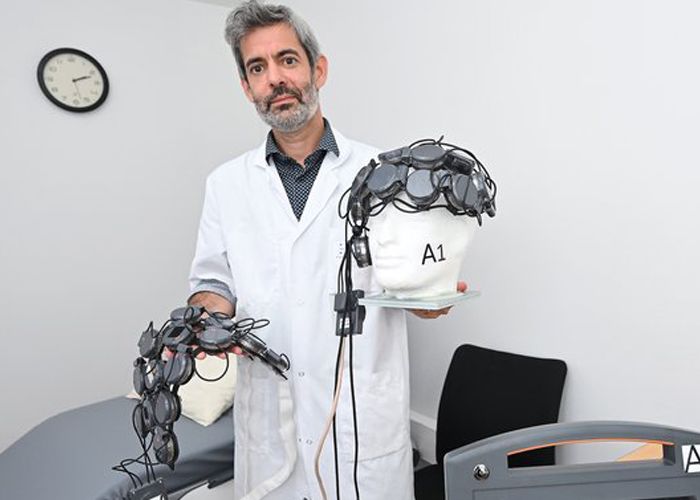
G.B : Transcranial photobiomodulation is still relatively unknown among doctors, which is precisely why a scientific approach is essential. At REGEnLIFE, we are developing pioneering technology, both in terms of its approach and its design. We are now well on the way to obtaining marketing authorisation for the first medical device for neurostimulation based on photobiomodulation. Our three-photon optical setup is specifically designed and optimised for safe and effective brain stimulation.
From the outset, we have adopted a rigorous scientific approach. To my knowledge, we are the first to develop a treatment that targets both the brain and the gut for neurological conditions, building on advances in the brain-gut axis. Our preclinical results also show that this dual administration (to the head to target the brain and to the abdomen to target the gut) produces superior therapeutic effects, whether in models of Alzheimer’s disease, depression or multiple sclerosis.
This rigorous work, carried out in collaboration with institutions such as the CNRS, Inserm, universities and university hospitals, has earned us recognition within the scientific and medical community. Our publications, like those of other research teams, help to legitimise this field and demonstrate that transcranial photobiomodulation deserves serious attention, as do other non-invasive brain stimulation techniques, for that matter.
That said, there are indeed some questionable practices: devices sold online, with no scientific basis or technical compliance, which claim to have unproven effects. This sort of malpractice fuels mistrust, and understandably so. But that is not our approach.
I often think of this quote attributed to Schopenhauer: ‘Every truth goes through three stages: first it is ridiculed, then it is violently opposed, and finally it is accepted as self-evident.’ I believe this will apply to photobiomodulation too, provided we can demonstrate it, step by step, through the scientific method.
M.F: At Regenlife, what is the belief that you defend tooth and nail… but which could cause division even within your own team?
G.B: At REGEnLIFE, I firmly believe that our neurotechnology must be developed in accordance with scientific and medical best practice so that it is recognised, credible and, above all, accessible to patients. For such a disruptive therapeutic innovation, which has no equivalent on the market, this means embarking on a long, risky and costly journey… but I am convinced that this is the only responsible and sustainable path. This requirement has sometimes put me at odds with certain strategic expectations, particularly within the board. At one point, the disagreement was so great that I considered leaving the company… In the end, I was called back, and we managed to find a balance. But yes, this vision can be divisive, as it requires time, rigour, and sometimes means turning down the easy option.
M.F: You say you want to improve the lives of patients with neurological disorders. But in practice, which is the hardest part: obtaining scientific validation or convincing clinicians?
G.B : In reality, the biggest challenge today is neither obtaining scientific validation nor convincing clinicians. The main obstacle is the implementation of the new European Medical Devices Regulation (MDR). Although designed to enhance safety, this regulation has become a real barrier to innovation, particularly for MedTech start-ups and SMEs. Many companies are struggling to survive, some are closing down, and raising funds is becoming even more difficult because investors are also being affected – and ultimately, patients are suffering even more… To give a concrete example: if we had developed our therapeutic technology – which, incidentally, has an excellent safety profile, particularly when compared with alternatives in neurology – under the old regulations (MDD), we would already be on the European market. Today, we must redouble our efforts to see this through, despite the obstacles. With our determination, we’re staying on course!
M.F: You’ve opted for non-invasive technology with a sleek design. To what extent do ergonomics and user experience influence your innovation decisions?
G.B: The user experience is obviously crucial, whether for the patient or the healthcare professional administering the treatment. But our top priority remains safety and therapeutic efficacy. This guides all our innovation decisions.
That said, we place great emphasis on design and ergonomics, as a well-designed device makes it easier for patients to adhere to their treatment and improves everyday usability. However, the new European regulation (MDR) significantly limits our ability to iterate quickly. Even the slightest change, however minor, entails a very heavy administrative and documentation burden, which hampers the agility that is essential for a truly user-centred approach and for medical innovation in general…
M.F: Finally, if you had to sum up in a single sentence the “battle” you’re fighting at Regenlife, without any marketing jargon, what would you say?
G.B : Our ‘mission’ at REGEnLIFE is to provide an innovative, effective, scalable, affordable, non-invasive treatment with few or no side effects, whilst remaining compatible with other approaches. This is in line with a holistic approach to therapy. We firmly believe in the value of combining different approaches: medical treatments, physical activity, nutrition, psychological and social support, and so on. This is particularly true in the field of mental health, an area to which we also contribute, as the treatment of depression forms part of our therapeutic pipeline. In this capacity, I have been appointed an ambassador for THE REAL Mental Health Foundation, which aims to improve the mental health of 10 million people by 2030. At the same time, I attended the Brain House and the Social Innovation House at the 2025 World Economic Forum in Davos, where issues relating to mental and neurological health were discussed. Mental health and brain health were identified as a ‘top priority’. My view is that we need major societal changes to foster greater innovation, social cohesion and a culture of sporting participation. It is essential for promoting mental and cognitive health, thinking clearly and helping us to cope better with our changing world.