
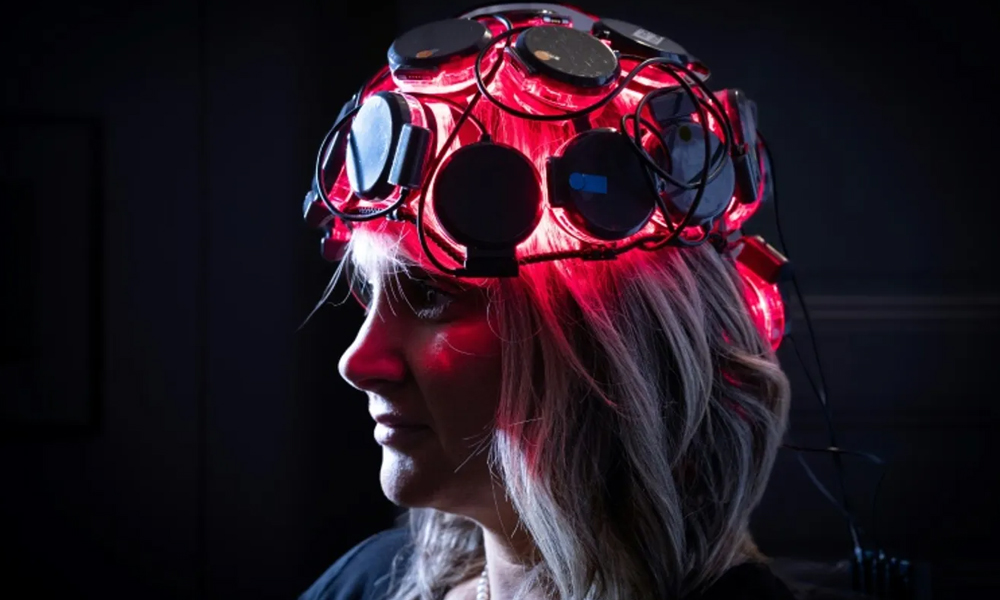
Former French women’s rugby team captain Marie-Alice Yahé undergoes a photobiomodulation session on February 19, 2024 in Paris – AFP – Alain JOCARD
“I can really see the difference”: in just a few sessions of light treatment, under a futuristic helmet, Marie-Alice Yahé, former captain of the French rugby team forced to retire after several concussions, has “returned to an almost normal life”.
Anxiety, claustrophobia, balance problems, irritability, headaches, depression, agoraphobia… Yahé hung up his boots almost ten years ago, on medical orders, but the after-effects of the shocks he received on the pitch have long plagued his daily life.
“I’ve got used to not being able to do certain things anymore,” she testifies. “I live with a sword of Damocles hanging over my head, because I’ve been told that neurological diseases can happen after the age of 40, and I’m afraid of it.”
Antoine Burban, a former Stade Français international third-rower whose career was also cut short by a series of concussions in 2022, mentions memory loss, difficulty sleeping and constant mood swings.
“My children, who are 5 and 6, don’t understand how I can go into a rage as soon as there’s something lying around the house,” he recounts, tears in his eyes. “You can’t prepare yourself to have another person in your head overnight.”
A huge step forward
Yahé and Burban began an experimental treatment in December, with weekly 20-minute sessions wearing a helmet that diffuses various light sources, notably infrared, towards the brain.
“Since then, I’ve returned to a more or less normal life,” says Burban. “It’s not over, I still have symptoms. But I know that I can spend a whole day with my kids without getting angry, that I’m not potentially going to scare them.”
Now a consultant on Canal+, Yahé has also stopped taking the medication she used to take before commenting on matches. She has regained stability and her dizziness has disappeared.
“I just wish they’d created this ten years ago,” she says. “Looking at the results today, they certainly would have given me my license back. It’s a huge step forward.”
French handball team goalkeeper Cléopâtre Darleux on February 23, 2024 in Brest (AFP – Fred TANNEAU)
French handball team goalkeeper Cléopâtre Darleux has also benefited, and is about to return to competition after more than a year without playing. “It was a last-chance protocol, and it worked,” says the Olympic champion with satisfaction.
Market launch within 2 years?
Dr Philippe Malafosse, a doctor at Montpellier’s professional rugby club, was the first to come up with the idea of using a technology for concussions, originally developed by the RegenLife company to combat neurodegenerative diseases such as Alzheimer’s disease.
Marie-Alice Yahé at the office of neurologist Jean-François Chermann, a specialist in sports concussions, on February 19, 2024 in Paris (AFP – Alain JOCARD).
With neurologist Jean-François Chermann in Paris, they treated around fifty athletes and analyzed the evolution of their symptoms and data, particularly visual and postural.
“I was perplexed before starting this study, but I have to admit that the initial results are very encouraging,” notes Dr. Chermann, a specialist in concussions in sport.
“We’re unlocking old files in one session. It’s incredible,” says Dr Malafosse. “We have hypotheses, but no explanations, except that we’ve put functions back into circuit that were inhibited.”
Antoine Dupont under the care of French team doctors after suffering a head injury against Namibia during the World Cup, September 21, 2023 in Marseille (AFP – CHRISTOPHE SIMON)
Director of RegenLife, a medical technology company founded eight years ago in the Montpellier region, Dr. Patrice Cristofini explains that photobiomodulation (light stimulation) acts on mitochondria to “regenerate diseased cells and calm the neuro-inflammatory mechanism”.
“We’re sure it works. It’s not invasive, we don’t implant electrodes. It’s not painful and it’s well tolerated, there are no side effects,” he assures us.
Convinced that it can “change the game” in the face of “a real public health challenge”, RegenLife hopes to market its funny light-up helmet within the next two years.