In France, a team of scientists is working on a promising clinical trial using photobiomodulation (a form of phototherapy) to simultaneously reduce brain and intestinal inflammation. They suggest that this safe, non-invasive therapy could treat Alzheimer’s disease.
Phototherapy
If you Google “light therapy”, you’ll find a thousand products promising everything from muscle relaxation to skin radiance to improved sleep. The market has been so inundated with these cheap, unverified wellness devices (Temu sells one for under $10) that it has partially obscured the essentials.
Phototherapy has several legitimate applications. One of these is photobiomodulation, or PBM. It’s not just about giving the skin a glow (which, according to the Cleveland Clinic, can be done by improving circulation). Decades of research, including media experiments involving astronauts in space, have demonstrated the impressive therapeutic benefits of exposure to red or near-infrared light. It turns out that, when properly performed, MBP triggers multiple phenomena at the cellular level, in the mitochondria, resulting in increased oxygen consumption, increased cellular energy, nitric oxide release and other beneficial effects. Functionally, this means it can reduce pain, reduce inflammation and accelerate healing.
So we know that these red and near infrared lights have therapeutic virtues and virtually no drawbacks. The question now is how and where to use them. The first applications are in dermatology, where this therapy has been FDA-approved for over 20 years, because it’s easy to illuminate the skin’s surface. But what if photobiomodulation applications were still in their infancy?
History of the origins
Meet Guillaume Blivet, an experienced medical technology executive living and working in the South of France.
Blivet spent the first decades of his career working for various companies in the healthcare and medical device sectors. One event led him to attend a dermatology conference and he found himself talking to doctors about their use of PBM therapy. He heard stories of PBM’s healing properties that impressed him, and heard of doctors also experimenting with “off-label” uses with positive results.
“I was impressed and interested by the efficacy results reported in patients, particularly for skin diseases,” explains Blivet.
He embarked on the research, curious as to whether PBM’s anti-inflammatory, analgesic and healing properties could be applied to other ailments. After all, with a mechanism of action located at the heart of the mitochondria, the energetic heart of the cell, it made sense that there might be additional benefits.
Blivet became aware of early studies on PBM and neuroscience, and began to think about potential applications for brain diseases. Could PBM be used effectively to treat, or even cure, Alzheimer’s disease? How could its therapeutic effect be enhanced for brain diseases?
It was a wide-ranging question, with global implications, and Blivet was captivated.
Under the hood
Blivet began by gathering around him a team of experts in neurodegenerative diseases, physics and engineering, including Professor Jacques Touchon, President of the Clinical Trials on Alzheimer’s Disease (CTAD).
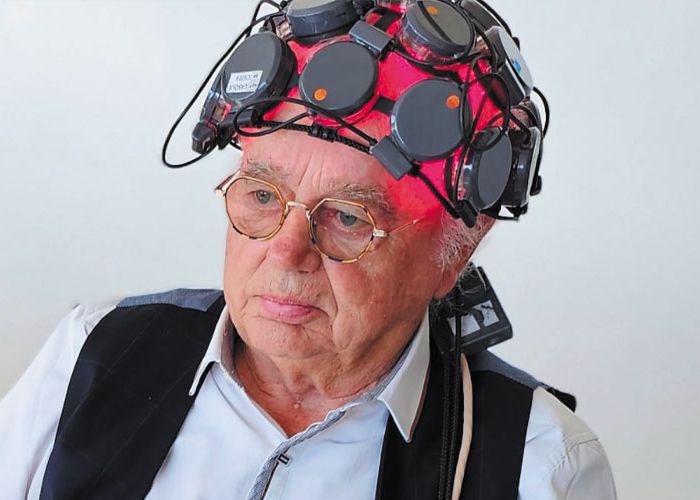
The first hurdle was to design a non-invasive, deep-penetrating PBM device to pave the way for a new treatment. The goal was to reach the targeted brain areas with PBM therapy. They therefore developed their own optical configuration, including lasers. Faced with the problem of light reflection from human hair, they built light guides that passed through the hair and reached the scalp directly. They integrated the whole system into a modular, ergonomic helmet, guaranteeing optimum diffusion and dose of light from the scalp to the brain.
Armed with a prototype and a grant from the French government, they carried out studies on mice. What’s special about these studies is that Blivet and his team didn’t just target the brain; they also administered PBM therapy to the gut. Given the deep connection between the gut and the brain, known as the gut-brain axis, and the fact that both the brain and the gut suffer from various inflammation-related conditions, the team felt that this dual approach could increase efficacy.
I thought that if the gut played a role in Alzheimer’s disease, we could target both non-invasively and thus have an additional chance of treating the disease,” explains Blivet. “We discovered a synergy between the brain and the gut that actually increased therapeutic efficacy.”
They were right, at least in mice. Their brain-gut application proved more effective than either brain-only or gut-only applications. The results were convincing, showing a normalization of short-term memory, long-term memory and Alzheimer’s disease biomarkers, as well as an improvement in inflammation biomarkers. The presentation of these results in a university setting aroused keen interest and helped raise funds for a first-in-man trial with 64 participants.
Then the COVID-19 pandemic struck, putting an end to face-to-face clinical trials. REGEnLIFE had to reduce the size of the trial. Despite these difficulties and a short treatment period (two months), the results were sufficiently convincing and the efficacy trend sufficiently clear to justify a pivotal trial over a longer treatment period (six months).
Next steps
Today, we are proud to welcome REGEnLIFE to StartUp Health’s Alzheimer’s Moonshot program, as they embark on the next stage of their entrepreneurial journey. Their current clinical trial, in patients with mild to moderate Alzheimer’s disease, is expected to deliver results by mid-2026. In the meantime, the team is working to obtain CE marking for its first EU medical device using PBM to treat the acute symptoms of concussion.
It’s an incredibly exciting step into the unknown. And if their work on these neurotechnological applications of PBM turns out as they predict – as their research suggests – REGEnLIFE could offer hope to millions of people suffering from neurodegenerative diseases.