
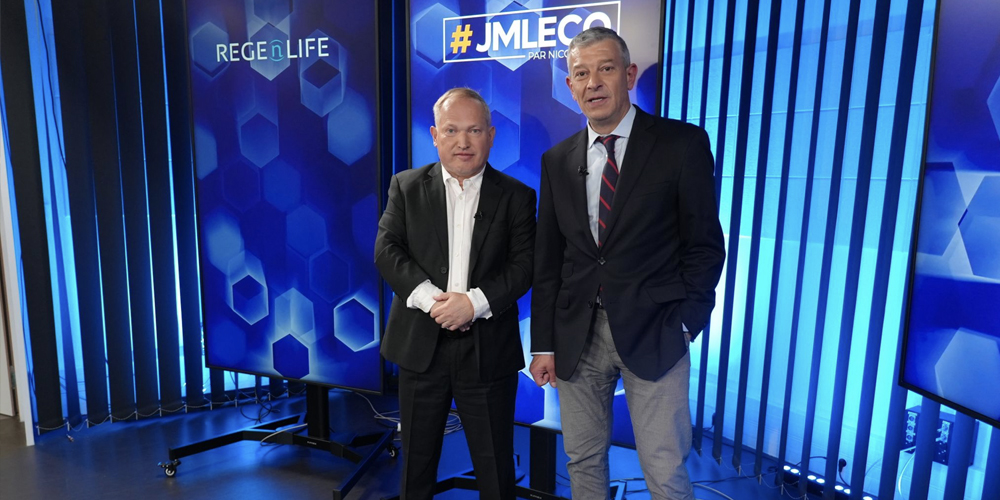
To treat patients suffering from Alzheimer’s or concussion, Regenlife is developing an innovative treatment based on light stimulation. After several promising studies, the company is pursuing its development, as CEO Dr. Patrice Cristofini explains.
What innovation does Regenlife offer?
Regenlife is a Medtech specialized in neurology. We treat the brain-gut axis with tri-photonic light stimulation. In our modules, a helmet on the head and a bib on the abdomen, we send out three light sources: red diode, infrared diode and laser. The photons activate the mitochondria in each cell, which are there to regenerate them and provide the energy they need to function properly.
In neurological diseases, we often observe neuronal degeneration and neuroinflammation, which we act on by regenerating the cells. We position ourselves as a non-invasive treatment that is unique in the world, as we are the only ones to combine these three photon sources with a combined and synchronous treatment of the brain-intestine axis.
Do you focus on neurodegenerative diseases like Alzheimer’s?
Alzheimer’s disease affects over a million people in France. With an aging population, this is a real challenge for medical innovation. The disease progresses slowly, and there is no truly effective drug treatment.
To address this public health issue, we carried out an initial double-blind study in humans two years ago, which had to be halted because of Covid. In addition to showing that our technology is safe and well-tolerated, it also produced significant results on certain cognitive tests.
We have a new multicenter study underway involving over a hundred people. We hope to confirm our initial results and prove that we could have an effect in delaying mild to moderate forms of Alzheimer’s disease. We’re aiming for initial results by the end of 2025, and hope to be able to launch commercialization in 2026 once regulatory approvals have been obtained.
Have you also started working on concussions, particularly in sport?
Concussion is a real international public health issue, but as yet there is no cure. To fill this gap, we have decided to focus part of our research on the treatment of this disturbance in brain function.
Following conclusive tests carried out by our partner doctors in their practices, we launched a major study at the Hôpital Européen Georges Pompidou in 2023, involving some 50 professional and amateur athletes. We were able to demonstrate a significant improvement, especially in the oculomotor tests carried out before and after each session.
We are now thinking of carrying out a study on people with sequelae following repeated concussions, adding the abdominal plastron to the treatment to add the influence of the microbiota.
The development of these new treatments faces numerous regulatory and financial challenges?
We are currently raising funds with the aim of finding 4 to 5 million in equity. These funds will enable us to pursue our R&D development over the next two years, as well as progressing towards CE marking for concussions.
Eventually, we plan to raise further funds to kick-start our international sales development.